



Research


1. Low-dimensional Electronics
Two-Dimensional Semiconductors for Next-Generation Electronics
We develop advanced two-dimensional semiconductor materials and process technologies for next-generation electronic and optoelectronic applications. Our research focuses on the controlled synthesis of high-quality 2D materials with tunable composition, band structure, defect density, and interfacial properties.
By integrating liquid precursor-mediated CVD, hybrid-MOCVD growth, and precise precursor supply control, we establish scalable synthesis platforms for monolayer and few-layer 2D semiconductors. These process strategies enable wafer-scale growth, defect engineering, doping control, and heterostructure design for device-compatible 2D material platforms.
From material design to process integration, our research aims to bridge fundamental 2D semiconductor science with practical applications in flexible electronics, wafer-scale devices, sensors, and low-power electronic systems.
Two-dimensional Materials
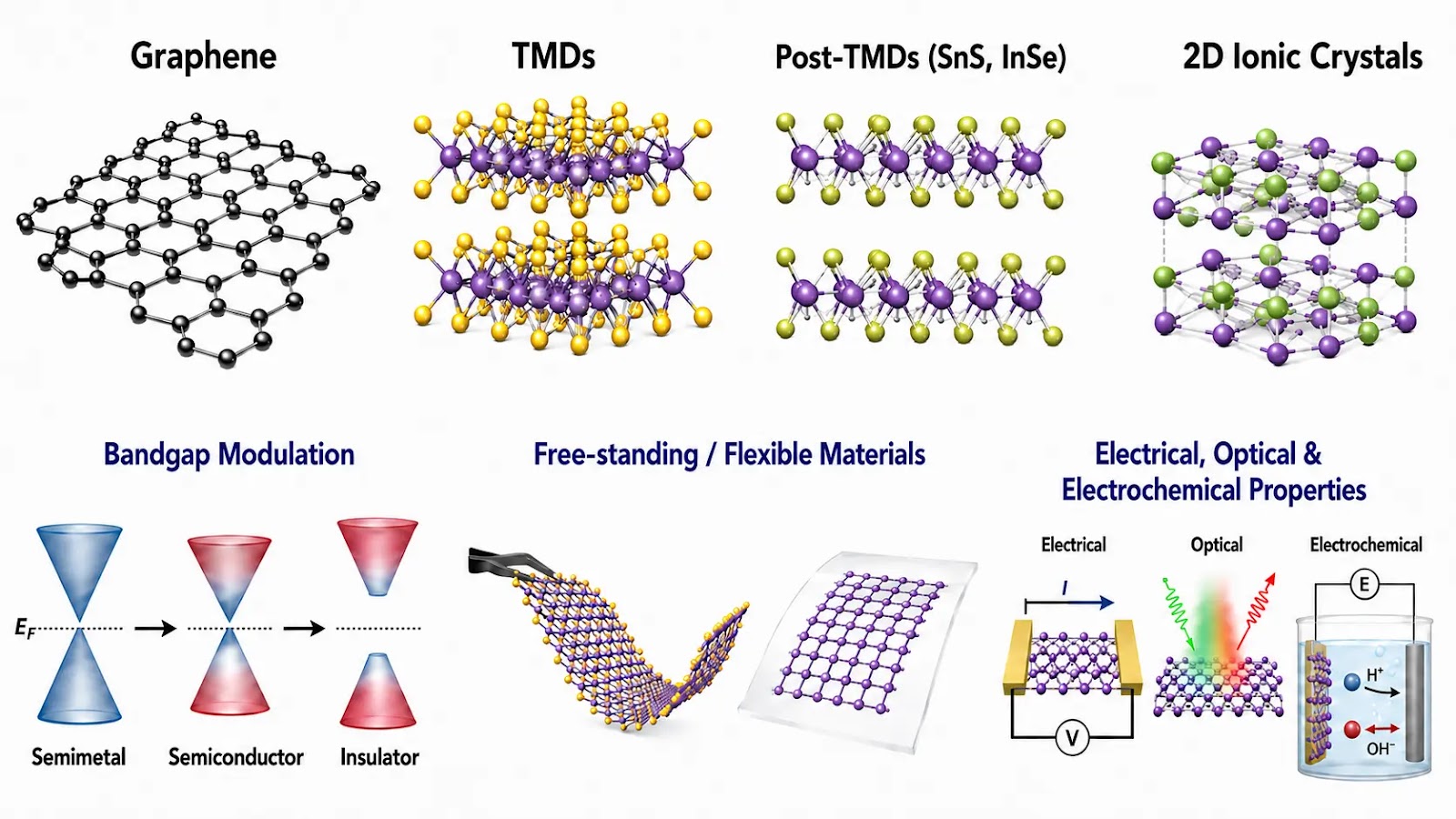
- Exploration of 2D materials
- Design of 2D material platforms with tunable multifunctional properties
- Application of low-dimensional materials to electronics, sensors, and energy devices
- Bandgap and composition engineering
- Free-standing and flexible material fabrication
- Electrical, optical, and electrochemical characterization
Process Technology for 2D Materials

- Scalable synthesis of various 2D materials
- Wafer-scale growth of monolayer semiconductor films
- Process control for high-quality and device-compatible 2D materials
- Liquid precursor coating and substrate preparation
- CVD / hybrid-MOCVD process design
- Temperature, pressure, and gas-flow optimization
Nano/Opto-electronics

- 2D semiconductor-based field-effect transistors
- Photodetectors and molecular sensors using atomically thin materials
- Electrical, optical, and optoelectronic property modulation
- 2D FET fabrication and electrical characterization
- Raman, photoluminescence, and molecular sensing analysis
- Contact, dielectric, and interface engineering
Neuromorphic & Advanced Device Platforms
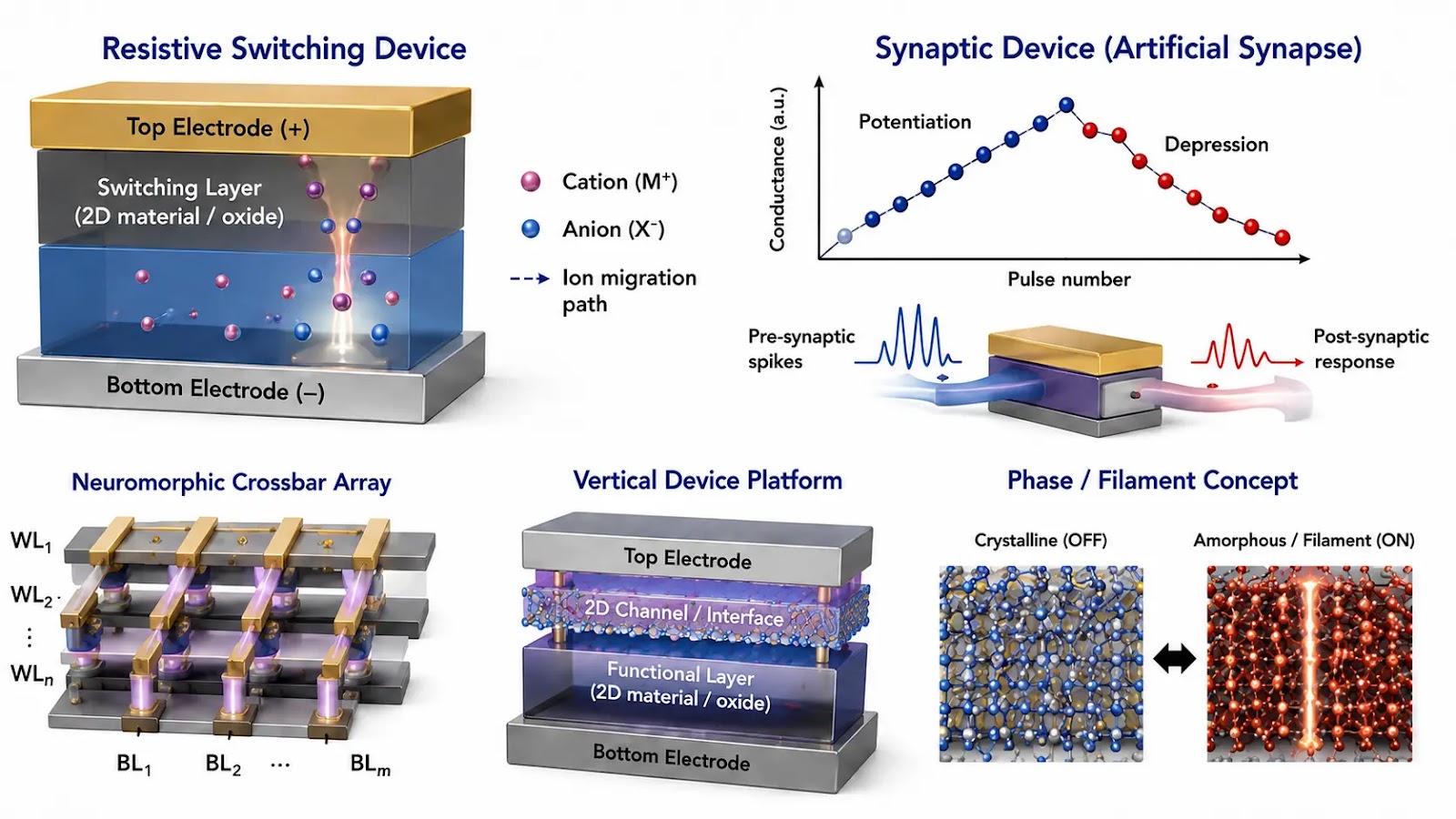
- Resistive switching devices based on 2D materials and oxides
- Artificial synaptic devices for neuromorphic computing
- Phase-transition and filament-based switching mechanisms
- Ion migration and defect-mediated switching control
- Synaptic plasticity modulation and pulse-driven operation
- Interface, phase, and filament engineering
2. Photovoltaic Cells
Perovskite Photovoltaics for Sustainable Energy Generation
We develop perovskite solar cell materials, device architectures, and fabrication processes for high-efficiency, stable, and scalable future energy technologies. Our research focuses on compositional engineering, interface passivation, charge-transport-layer optimization, and defect control to improve photovoltaic performance and long-term operational stability.
By integrating solution processing, vacuum deposition, self-assembled molecular contacts, and interlayer engineering, we establish high-performance perovskite solar cells. These strategies enable efficient charge extraction, reduced non-radiative recombination, suppressed ion migration, and enhanced film quality.
From material design to device integration, our research advances perovskite solar cell technologies toward practical single-junction and tandem photovoltaic applications for sustainable energy generation.
Properties of Perovskite Materials

- Optoelectronic property control of perovskite materials
- Perovskite absorber design for high-efficiency solar cells
- Composition engineering for efficiency and stability enhancement
- Bandgap tuning for targeted solar-spectrum absorption
- Charge transport enhancement and defect-tolerance control
- Perovskite precursor doping and composition engineering
Fabrication and Characterization of Perovskite Solar Cells

- Solution- and vacuum-based fabrication processes for PSCs
- Layer-by-layer integration of perovskite solar cell devices
- Process optimization for efficient and reproducible photovoltaic performance
- Spin coating and hot-plate annealing under inert atmosphere
- Sputtering, ALD, and perovskite co-evaporation
- HTL/perovskite/ETL/electrode stack fabrication
Efficiency and Stability Engineering of Perovskite Solar Cells
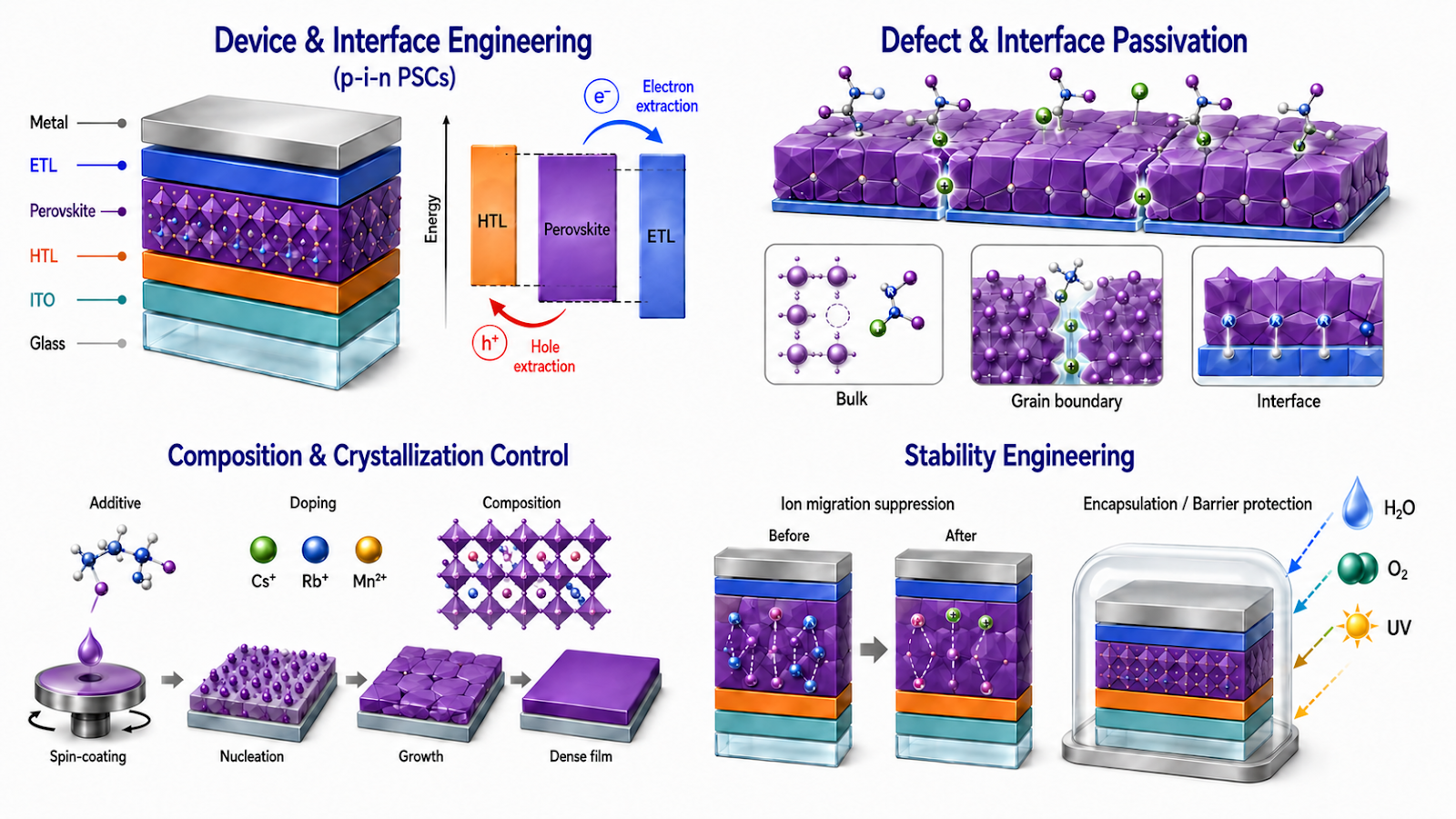
- Interface engineering for high-efficiency inverted p–i–n PSCs
- Defect passivation and ion-migration suppression for long-term stability
- Composition and crystallization control for stable, high-performance perovskite films
- Energy-level alignment and charge-transport optimization
- Bulk, grain-boundary, and interface passivation
- Additive, doping, and composition engineering
- Crystallization control and encapsulation/barrier-layer design
Tandem Solar Cells: Perovskite/Silicon & All Perovskite Tandem
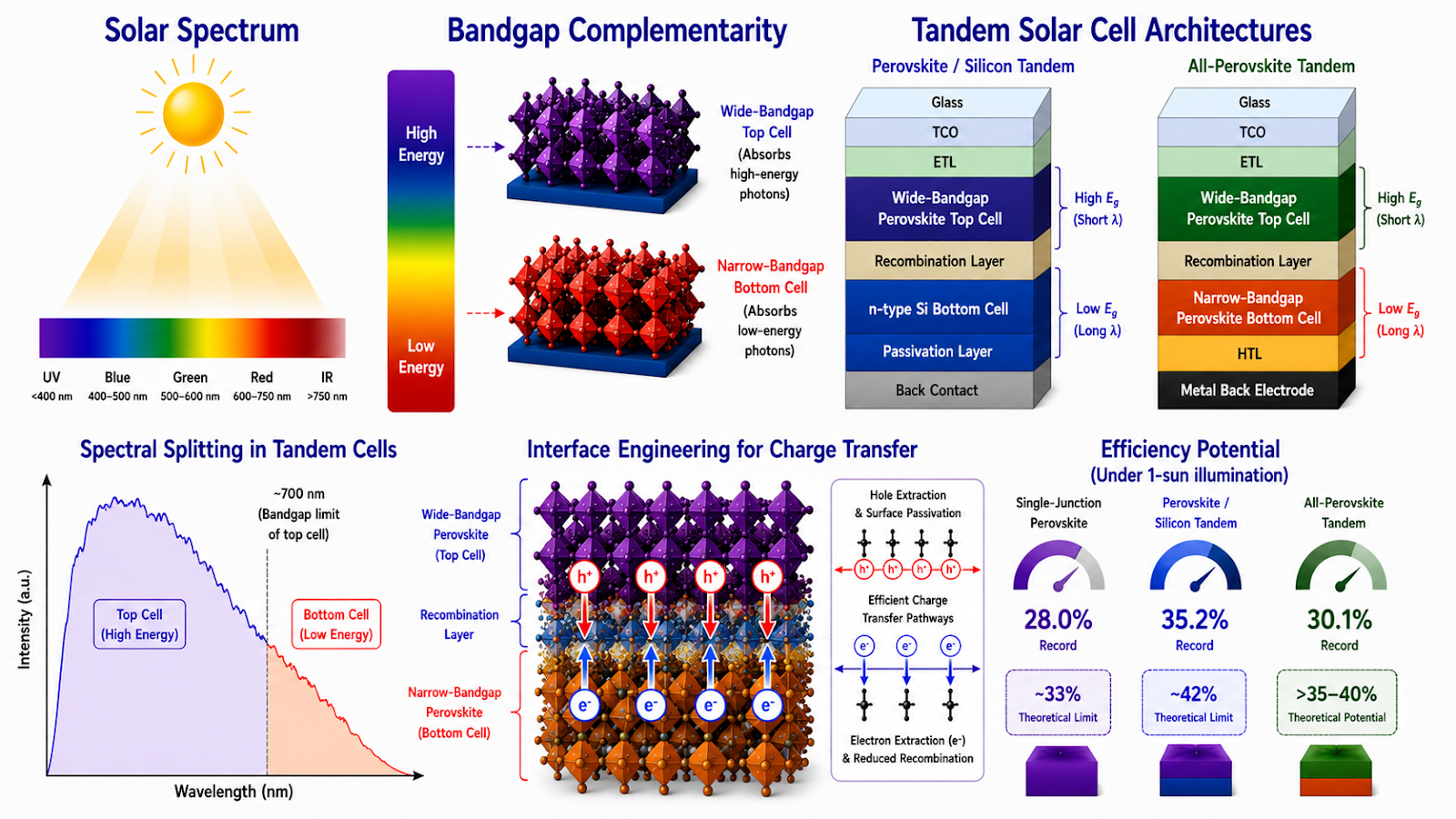
- High-efficiency tandem solar cells beyond single-junction limits
- Perovskite/silicon and all-perovskite tandem photovoltaics
- Complementary absorption of high- and low-energy photons
- Spectral splitting and light management for high-energy and low-energy photons
- Wide-bandgap top cell and narrow-bandgap bottom cell optimization
- Interconnection, charge transport, and interface layer engineering
3. Electrocatalysis
Electrocatalysis for Sustainable Energy Conversion
We develop advanced electrocatalysts and electrochemical systems to enable sustainable hydrogen production and carbon-neutral chemical conversion. Our research addresses key bottlenecks in water electrolysis across acidic, alkaline, neutral, and seawater environments, with a focus on achieving high catalytic activity and long-term durability at practical current densities.
By integrating composition tuning, defect engineering, interface regulation, and electrode-structure design, we design robust catalytic systems for challenging electrochemical conditions. Beyond water splitting, we explore tandem electrochemical architectures that couple hydrogen evolution with CO2 conversion and biomass upgrading, opening energy-efficient routes to value-added chemical production.
From atomic-level catalyst design to practical device integration, our research advances electrochemical technologies for a sustainable energy and chemical future.
Alkaline Water Electrolysis
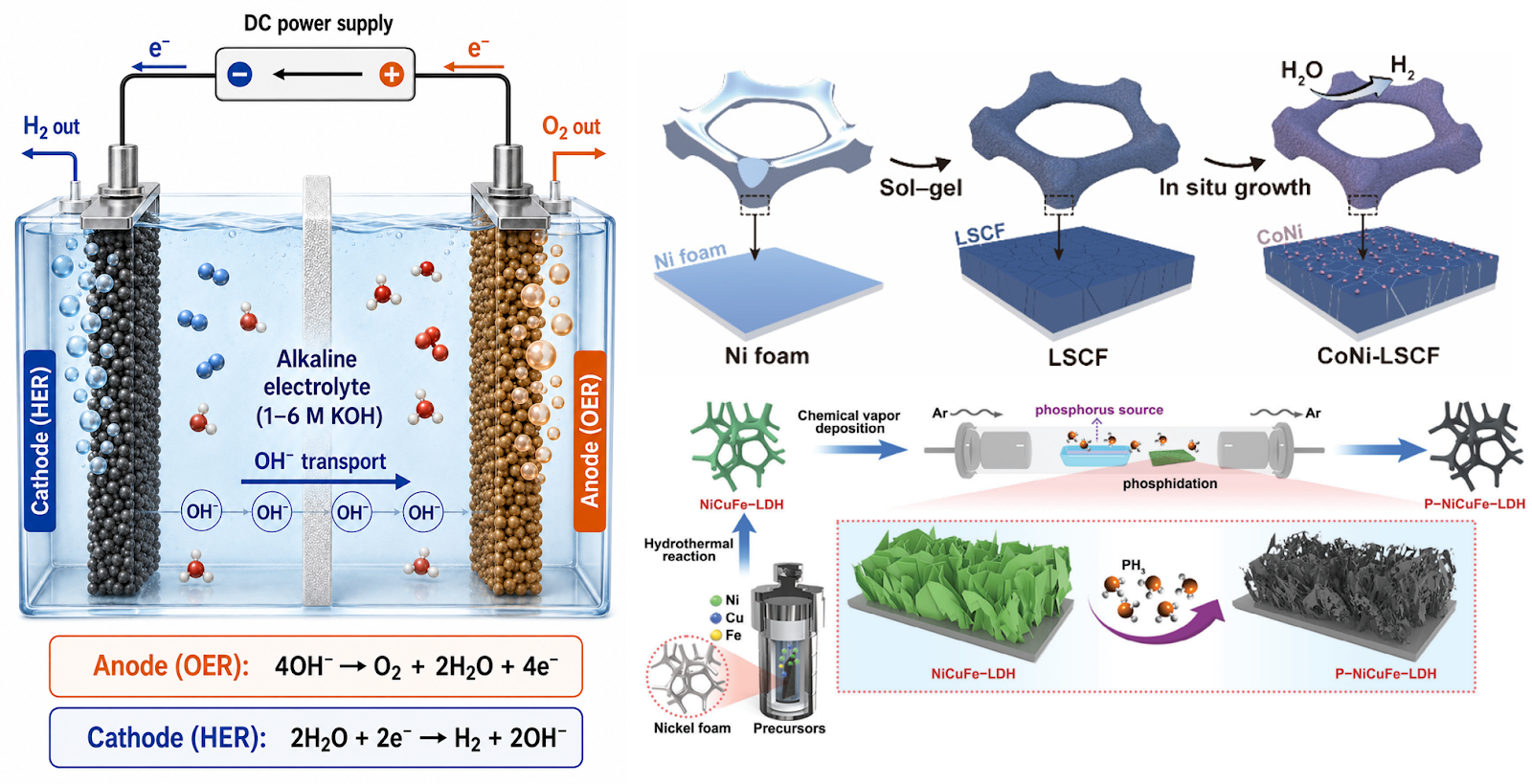
- Non-precious HER electrocatalysts in alkaline media
- Development of electrocatalysts operating at industrial current densities
- Interface & morphology engineering
- Electronic structure tuning
- Surface reconstruction
Acidic Water Electrolysis
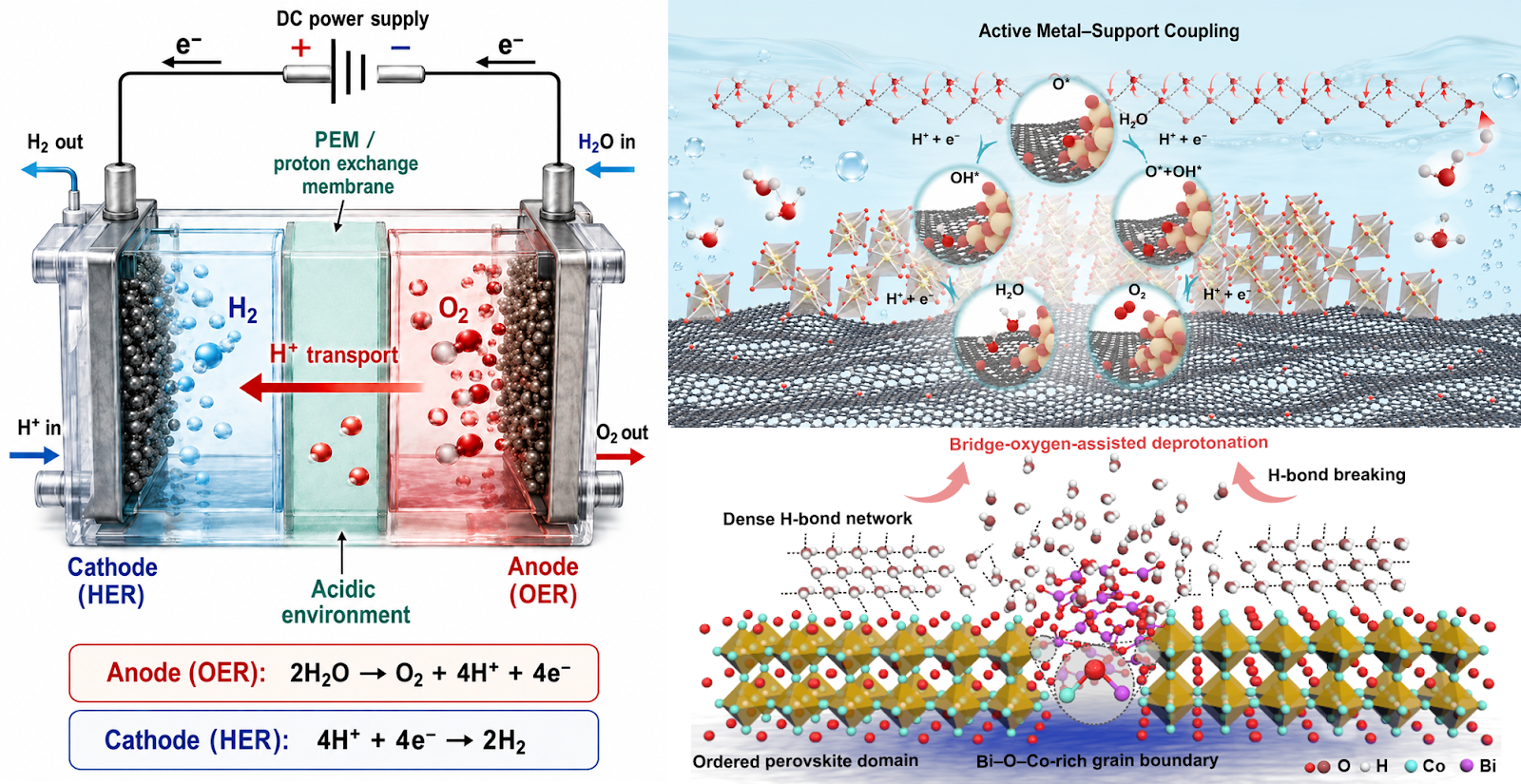
- Acid-stable OER catalysts for PEM water electrolysis
- High activity and long-term durability in acidic media
- Active metal-support coupling
- Interface regulation and reaction pathway control
- Suppression of catalyst dissolution and degradation
Neutral & Seawater Electrolysis

- High-activity HER/OER electrocatalysts optimized for pH-neutral environments
- Selective water splitting over chlorine evolution reaction (CER) in raw seawater
- Local pH regulation via catalyst surface modification
- Amorphous protective layer architecture for anti-corrosion and high durability
- Asymmetric heterointerface & defect engineering
Tandem Electrochemical System

- Simultaneous hydrogen production and high-purity CO2 generation
- Coupled HER and biomass upgrading to reduce energy demand
- pH swing control via CO2/CO32- redox cycling
- Membrane-electrode assembly/zero-gap electrolyzer design